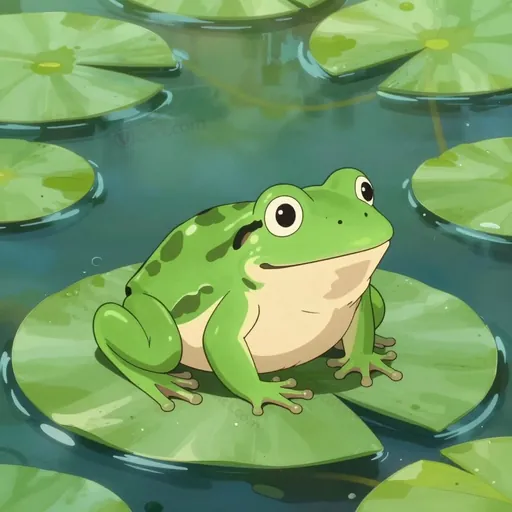
true frog
Definition
Noun: 1. A member of the family Ranidae: "True frog" refers to any amphibian belonging to the biological family Ranidae. These are typically insect-eating, often semi-aquatic animals with webbed feet, smooth moist skin, and long hind legs adapted for jumping and swimming.
Usage
- The term "true frog" is used in herpetology (the study of amphibians and reptiles) and general biology to distinguish typical frogs in the family Ranidae from other frog-like amphibians, such as toads (family Bufonidae) or tree frogs (family Hylidae).
- It is a common name, not a scientific one, but it corresponds to a specific taxonomic group.
Examples
- Noun:
- The common leopard frog is a classic example of a true frog found in North America.
- Biologists study the decline of true frog populations as an indicator of wetland health.
- Unlike toads, true frogs usually have smoother skin and are more closely tied to aquatic environments.
Advanced Usage
- "Ranid": This is the adjectival form and a less common noun synonym used in scientific contexts.
- The ranid species diversity is highest in tropical regions.
Variants and Related Words
- Ranid (n. & adj.): Pertaining to or a member of the family Ranidae; a technical synonym for "true frog."
- Frog (n.): A broader common name for any tailless amphibian in the order Anura, which includes true frogs, toads, and tree frogs.
Synonyms
- Ranid (scientific synonym)
Notes on Meaning
- The term "true frog" highlights a specific biological classification within the broader category of "frogs." It is used for precision. In everyday conversation, most people simply use the word "frog," which can refer to any anuran. The "true" designation becomes important when discussing specific traits, evolution, or scientific classification.
Noun
-
insectivorous usually semiaquatic web-footed amphibian with smooth moist skin and long hind legs